May 31, 2007

pretty vegas - final thoughts


so the time is finally upon me to post my final thoughts about new communication technologies for semester 1 2007. i must say that this course has by far been my favorite this semester. i covered topics that i was interested in and also showed me new topics that are quite interesting such as french new wave cinema, cyberpunk and virtual reality. the screenings each week were fantastic and werent things that i would usually watch. so that enabled me to get a new perspective and outlook on other forms of technologies that i wouldnt have thought of if i had not taken this course. overall the content was interesting and i found myself looking forward to what we would learn next. however one thing that i found less interesting was some of the tutorial work. the photoshop and microsoft office tasks were way to easy for me but that is most likely due to the fact that i spend alot of my time using those programs. they could maybe be a bit difficult next time but then again people taking the course might find it hard so its a no win situation. besides that i found the tutorials fun as well as the assessment. the course was enjoyable and i would definetley take it again if i was a doing first year again. stephen stockwell is a great lecturer and i hope i can be in some of his future classes and jules was an awesome tutor. now all that remains is the exam.....................


well that was my final blog post. for those of you who actually read this then farewell

carrisa.

May 28, 2007

where does it hurt - lecture notes

well here is my last lot of lectures notes ever. its kind of bittersweet but i will post one final blog on my thoughts about that issue at a later time. until then here are the lectures notes for the week 12 lecture on creative commons/free and open source software--------

points brought up included------
Mac vs. PC
iPod

Free Software,Open Source,Creative Commonsiet
  • propary software - software that is owned by the company who sells it
  • source code - usually locked, cant change the program without access to the code

FREE AND OPEN SOURCE SOFTWARE REFERS TO A KIND OF SOFTWARE THAT IS DIFFERENT TO PROPIETARY SOFTWARE IN A NUMBER OF SIGNIFICANT WAYS

founder of the free software foundation is a guy named Richard M. Stallman

MICROSOFT is the main owner of propietary software

  1. FIREFOX is an alternative to internet explorer
  2. OPEN OFFICE is an alternative to microsoft office

we also touched on the lennux operating system and what not but that really doesnt interest me ha um this lecture really didnt interest me. the topic was good but it is not something that i am really interested in. plus the end of primer was confusing.

well thats all. my last post will be soon so until then----
-carrisa

ps. here's a video to end the post


the breakdown - lecture notes

here are the lecture notes for week 11. the lecture was about Cyberpolitics and here are my notes........

Digital Divide
The major issue in all discussions of cyberpolitics is the digital divide: only some people have access to computers and even less to the internet, so how can everybody's interests be represented in on-line debate?

On-line Democracy
It is important to distinguish between the idealist view of a democracy on the web encompassing all citizens (cyberdemocracy) and the democratic uses of the internet to improve the quality of access to existing democracy.

Defining Democracy
The 1980s saw the near-universal triumph of liberal democracy and its representative institutions.Some apparently simple definitions of democracy continue to inform popular discussion: the rule of the many ; the rule of the majority and; 'government of the people, by the people, for the people' are three common formulations.

Gaps in the Mass Media
The increasing concentration, centralisation and commercialisation of the mass media appear to have foreclosed avenues for democratic participation in currently existing representative democracy. However, a number of theoretical counterpoints and interventions suggest that there may be ways in which the arena of deliberation, or the public sphere, may be extended via the application of new communication technologies and a better appreciation of the power of the audience.


Free Speech and Censorship
'The Net interprets censorship as damage and routes around it. '- John Gilmore


Black Holes
Although it is theoretically possible to slow time by an infinite amount and almost bring it to a standstill you can never reverse it. Time is halted, however, in Black Holes. This is because gravity dilates time. The gravity on a neutron star is already enormous, and if you shrink the star even further there comes a point where you will reach an almost infinite time warp. A clock on the surface of that shrunken neutron would appear to be completely frozen in time - if we could see it.

We also watched this movie called Primer. It was extremely confusing but I managed to make out that they were time travelling or something. I did some further research on the movie in order to understand it better and here is what I found -
  • Primer is a 2004 independent film written, directed, produced by and starring Shane Carruth. A sci-fi puzzle thriller, it explores the effects of an accidental invention on its two creators.

  • Famously produced for $7000, the film played at festivals, collecting the Grand Jury Prize at Sundance in 2004, before receiving a limited release.

  • There is about 9 timelines in the film and I think that is really crazy and confusing but here is a diagram to explain them. Source is http://en.wikipedia.org/wiki/Primer_(film)

http://upload.wikimedia.org/wikipedia/en/0/03/PrimerTimeline.gif

okay and that is all there is for now. this is like one of my last blogs for this class but i write about that later.

until next time
carrisa.


May 21, 2007

anyone but you - lecture notes


ladies and gentleman, boys and girls it is now time to publish my lectures notes on the topic known as cyberpunk. this topic interested me with it's interesting topics such as cities as machines lol anyways enoufh of my sillyness and onto my notes -


  • Cyberpunk is a science fiction genre based in the possibilities inherent in computers, genetics, body modifications and corporate developments in the near future. The word comes from the amalgamation of Cybernetics and Punk.

  • The term cybernetics comes from the Greek kybernetes which means steersman or pilot and the concept developed during and after WWII to indicate the use of a systematic approach to complex issues such as managing a large number of computers at distributed sites or understanding the operationms of the brain.

  • Punk was represented in the music of bands such as Sex Pistols, Clash & Black Assassins

William Gibson is a US/Canadian writer whose fictional work has spawned a number of key concepts like 'cyberspace' and 'virtual reality'.


cyberpunk THEMES


  1. Technology and Mythology

  2. Utopia and Dystopia

  3. Cities as Machines

  4. Technological Change

  5. Modernism to Postmodernism

and those were my notes for cyberpunk.


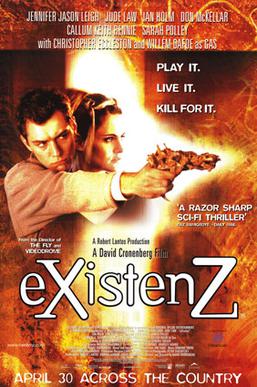
we also watched a movie starring jude law and jennifer jason lee; this movie was eXistenZ. it was directed by canadian director david cronenberg who also directed a history of violence. overall i thought the movie was interesting and i really didnt see that ending coming. quite a good little twist. here is a little snippet from wikipedia.org about the interpretation of the movie-


  • the story is based on the confusion between reality and virtual reality as the characters move in and out of a quasi-organic role-playing computer game called eXistenZ, the aim of which is unknown. The players are linked to the virtual world of the game by a console that resembles a living lump of animal tissue which is connected to the player's nervous system through a 'bio-port' drilled in the player's lower back; however, near the end of the film the gamers seem to be connected to the virtual world by electronic devices connected to their heads and wrists. The ending, immediately following that switch into what appears to be a real world in which gamers were merely playing virtual reality, with electronic devices on their hands and wrists, leaves open the question of how many layers of virtual reality are still left between characters and the real world.

well thats all for this blog there isnt anymore
carrisa.

another thin line - lecture notes


okay it's time to catch up on lecture notes lol so here are the lecture notes from lecture 7 which was about games theory-------


Video Games Studies includes the following types of games:
Arcade
Games
Consoles
Computer
Games
MUDs
MMOGs


  • Narratology vs Ludology vs ... ?
    Narratology is the study of video games from the perspective of them being stories or literary works.

    Ludology, in contrast to narratology, is concerned with the Game Play elements.

there was also some stuff on what is real and what is virtual? those questions to me are so broad it would take me forever to even begin to answer them. lol so that was my lecture notes on games. it wasnt really a topic that interested me considering i haveny played my playstation in like a year. it's collecting dust. lol


until the next lot of notes.
carrisa.

darkness round the sun - tutorial task


so this weeks tutorial task involved microsoft excel. that program seriously annoys me lol i had to do an accounting assignment the other week and had to use excel and it would not co-operate with me but luckily for me excel did indeed co-operate today. we started with the basics of excel which was entering data and doing formulas and what not and that is seriously the easiest thing in the world. next we did some graphs of the data we had entered and that is easy as well. a little to easy if you ask me but that's only because i have done it like a million times before due to taking business at school for three years. the final part of this weeks task was about macros. the good thing is i had never used marcos before so it was basically a new learning experience and a good one at that. i found marcos quite easy to grasp and overall the task was good. now onto my review of the task. i found it way to easy. there was nothing difficult about it lol thats only because i have experience in excel which is lucky for me. this program will be extremely useful to me in the future as i am also doing a business degree and excel will be used frequently in assingments. yay for me.

well this blog for this task is over for now but i will post a video to end it with and that video will be kelly clarkson's new song titled 'never again'. til next blog

carrisa.


May 14, 2007

pick up the pieces - tutorial task


well i actually did this week's tutorial task and it only took me like 25 minstues. it involved microsoft word and using new features within the programs. most the things i had already knew thanks to studying computer studies and business at school. the one thing i didt know how to do prior to this task was the mail merge thing but i found it quite easy to work out and use. it might come in handy in the future. the overall task was a good idea for those who werent to sure how to use microsoft word and some of it's features but for those of use who do it was a nice refresher course. microsoft word is very useful to me as i am a windows user (next computer i buy is a mac though!!) and it usually the program in which i do all my word processing.


so that was this weeks task and to end this blog entry i will post a little video clip of..............................one of my favorite tv shows grey's anatomy.


okay until the next entry which will be me catching up on lectures notes.....peace out
carrisa.

May 10, 2007

essay- the online music epidemic

HYPOTHESIS
The internet has helped revolutionize the music industry

ESSAY- The Online Muisc Epidemic
Recent years have seen a shift in how music consumers access their music. Online music piracy continues to be a major problem for the music industry; though is it really? ‘In the past few years there has been a marked increase of music piracy mostly due to new technologies that facilitate the downloading and sharing of music’ (Berger, Jong, Nadonly, 2001). Ivey and Mackay (2004, pg.92) point out that ‘new media’s greatest significance may lie in the impact they are having on older media – which are developing new forms, using new technologies and being regulated in new ways’. With the creation of sites such as ‘MySpace’ and ‘YouTube’ and Peer 2 Peer programs including ‘Kazaa’ and ‘LimeWire’, users are now able to download music without having to pay a cent. However due to these sites and programs many artists are now getting discovered and landing record deals. With every negative there is always a positive and this is evident in the issue at hand. Besides the fact that music piracy is illegal; the invention of these new technologies had helped revolutionize music for the 21st century.

A question that arises when thinking about online music piracy is ‘what exactly is online piracy?’ According to Corredor, (2007) online music piracy can be defined as playing or downloading from the Internet songs and lyrics without getting authorization to, and without compensating the artists. Since he demise of Napster; downloading and sharing recorded music in the forms on MP3 and other audio files has become more prominent than ever. This has caused CD stores sales to drop my 20% every year (American Federation of Musicians, 2004). According to Laing (2004, pg. 88) the figure for record sales in 2002 was ‘almost 8% lower than the total of 2001 record sales’.It has been said that peer to peer programs such as LimeWire and Kazaa are responsible for more than 2.6 billion downloads each month. Over a year that is more than 30 billion files downloaded illegally each year by users of peer 2 peer programs.

The program Kazaa is one the leaders in peer to peer sharing. It has become on the most downloaded programs worldwide. Besides Kazaa, there is over 20 more peer to peer networks that allow the sharing and downloading of copyrighted material. These include the Bit Torrent network which supports 21 applications. The number of users using these programs in unknown but by looking at the number of downloads per month the number of users would likely be in the high millions. Also the word MP3 had replaced ‘sex’ as the most searched for word on the internet (Corredor et al, 2007). This shows that users today are far more interested in downloading pirated tracks for free.

However what many users fail to realize is that there are potential risks with downloading music online. Not only is it illegal but users of the peer to peer networks also upload viruses with their files. Things such as spyware and malware are uploaded into the networks and these two things can be extremely harmful to your computer if opened. Besides the risks for your computer; there is also the legal ramification if a user is caught. Music is deemed as intellectual property and as stated by Berger et al (2001) ‘theft of intellectual property is rampant on the Internet. The music business and its artists are the biggest victims’.
Each day millions of pirated songs are being downloaded and under that intellectual property act the downloading of this music is known as copyright infringement. All music is copyrighted by the artists and record companies; when piracy takes places that copyright has been breached. Each jurisdiction has different laws and penalties regarding music theft (piracy) but they are generally the same. Most cases are mainly prosecuted through private lawsuits where monetary damages are usually claimed. In recent years there have been many famous cases regarding the theft of music which includes Napster vs. Metallica. ‘Metallica filed suit against Napster and three universities for copyright infringement and racketeering’ (Cretsinger, Menell, 2001). After that case Napster was shut down and instead was re launched not as a peer to peer network but as a programs which requires users to pay for tracks downloaded.

Record executives view piracy on the internet as a negative issue and cannot see the potential that it beholds. Breen (2004, pg.81) points out that ‘the drama of change is such that consumers who download music haven been characterized as enemies of the music industry’. Consumers downloading music is one of the biggest problems the music industry faces today. On the other hand it also provides a revolutionary new medium that enables the industry to grow and reach a new era. Music on the internet allows the various record labels greater access and knowledge of the consumers who buy and listen to the music their labels produce. The internet also offers artists a creative outlet that permits them to be more in touch with their audience. Artists today now have a MySpace music page that allows users to listen to their music but are unable to download it. MySpace also gives unsigned artists the chance to post their music on their page. This allows those artists a chance to get their music out into the world. These new technologies have enabled the success of many bands such as Koopa who ‘scored a top 40 hit despite no record label or any physical copies of their CD on sale’ (Fildes, 2007).

Artists such as Lily Allen and the Arctic Monkeys owe much of their success to the internet. Their music was listened to by the online fans that went out and purchased their CD’s and those who purchased them on iTunes. Genevieve Read (2005) points out that iTunes ‘marks the biggest event in music since the birth of the CD’. iTunes which was developed by the creators of the iPod, Apple computers; offers music goers the option of downloading songs from their online store for a fraction of the price it would cost to purchase them offline. According to the Associated Press (2004) downloading music online is ‘unburdened by manufacturing and distribution costs, online music was supposed to usher in a new era of inexpensive, easy-to-access music for consumers. In many cases, buying music online is still cheaper than shopping for CDs at retail outlets’.

With the invention of online music stores; the music industry is making it much easier for consumers to reach their product while at the same time making a profit. Items such as the iPod and other MP3 players have changed the way we listen to our music. On the other side programs such as the peer to peer networks and iTunes have changed the way we access our music. We can either download it illegally for nothing or download from a reputable program for a fraction of the cost. Either way the way we access our music has changed with the help of new technologies. With the help or MySpace and YouTube, unknown artists are getting the opportunity to get their works heard and already established artists are able to reach their fans and build a bigger fan base. According to the NHC Action for Children (1997) ‘the internet has become a vast library which you can bring into your home’ thus allowing down loaders to bring a vast and diverse music library into their homes. The internet has revolutionized music and the music industry and while record companies may think it is for the worse; music enthusiasts agree that it is a new wave of great technology.

References Links

American Federation of Musicians (2004) ‘Online Music Piracy’
http://www.afm.org/public/departments/leg_issues_05.php (Accessed 30 April 2007)
Associated Press (2004) ‘ Speaking of Music Piracy’
http://www.wired.com/entertainment/music/news/2004/04/62995 (Accessed 30 April 2007)
Berger. Melinda, Jong. George, Nadolny. Alexis (November 20 2001) ‘The Evolution of Online Music Piracy’
http://www.bsos.umd.edu/gvpt/its/piracyfall01/finalpaper.htm (Accessed 30 April 2007)

Breen, Marcus (2004) ‘The Music industry, technology and utopia – Busting the fans – the Internet’s direct access relationship’ Popular Music 23(1):79-82, Cambridge University Press, London

Caldwell, John .T and Everett, Anna (ed) (2003) ‘New Media – theories and practices of digitextuality’, Routledge, New York and London

Corredor. Nathalie, Gu. Yixin, Guerra. Elaine, Hill. William and MacQuarrie. Rebecca (2000) ‘Music CD Industry FAQ’
http://www.soc.duke.edu/~music/piracyfaq.html (Accessed 30 April 2007)

Cretsinger, Cathy E. and Peter S. Menell, (2001) ‘Annual Review of Law and Technology: Foreword’ 16, Berkeley Technology Law Journal,
http://www.lexis_nexis.com/universe (Accessed 30 April 2007)

Fildes, Nick (18 January 2007) ‘Music industry threatens ISPs over piracy’ The Independent,
http://news.independent.co.uk/business/news/article2162919.ece (Accessed 30 April 2007)

Ivey, Darren and Mackay, Hugh (2004) ‘Modern Media in the Home’, John Libbey-
CIC Publishing, Rome Italy

Laing, Dave, (2004) ‘World Record Sales 1992-2002’ Popular Music 23(1):88-89, Cambridge University Press, London

NCH Action for Children (1997) ‘Young People and the Internet’ The Computer Age : Issues for the Nineties Volume 85, The Spinney Press, NSW Australia.

Read, Genevieve (30th October 2005) ‘Nothing to fear as Teens tune Out’ Current Social Issues 105(20):20, Australia

May 2, 2007

devil's party - lecture notes


here are my notes for lecture five on the history of the internet/virtual philosophy.......


  • the internet, the web and cyberspace…..
    internet is a network of networks. Those networks include
    servers
    mainframes
    and personal computers
    they are loosely interconnected by the telephone system and more recently broadband cable and satellite services; to link people around the world into an information sharing system.

  • world wide web (www. or web)
    the world wide web is one particular use of the internet that emerged in the 1990’s as people generally began to see the potential for computers to communicate with each other as a matter of course. The web emerged techniques of internetworking and hyper text to make an easy to use but powerful global system that shares all information accessible as part of a seamless hypertext space. The web includes all the internet sites that people have made available on servers around the world.

  • cyberspace
    a conceptual space where words, relationships, data, wealth and power are manifested by people using computer mediated communication technologies. Is it a ‘consensual hallucination’ or a virtual reality?? It might be a third activity, actually real enough when you can make a living out of it. We must distinguish virtual communications of cyberspace from virtual reality.

  • early internet applications
    electronic mail (email)
    file transfer protocol (ftp)
    internet relay chat (irc)
    mud’s, mushes, moo’s etc

  • most recent internet applications
    im
    peer 2 peer
    blogs
    portable audio and podcsting
    3g mobile
    Web 2.0

well those are my notes...until the next lot
carrisa.

hungry - lectures notes


well im catching up on lectures notes and here are the notes from lecture four when we had a guest speaker; former student and now pr exec Katie. She now works for her own PR Company; ‘square one PR’. Some of the things she mentioned during her talk were

  • Get the most of Uni

  • Get Experience

    She also mentioned what the media want

    LOCAL family, children, animals, not for profit
    METRO statistics, trends, high profile people
    NATIONAL hard news, profiles, industry professionals
    MAGAZINE
    BROADCAST high profile stories, controversy, visual
    ONLINE highly specific information, opinions, hot industry topics

so that’s the notes for lecture four. i actually found this lecture very interesting because I may be interested in a career in PR.

Until the next lot of notes
Carrisa.

About me

  • I'm c a r r i s a
  • From Robina, QLD, Australia
  • hey ya'll :) i'm carrisa and this is my blog....well atleast my blog for new communication technologies..... my interests include music,movies,tv,celebrity gossip,fashion and a lot more.....
My profile
Google Docs & Spreadsheets -- Web word processing and spreadsheets. Edit this page (if you have permission) | Report spam